
Students face off in distressed debt investment pitch competition
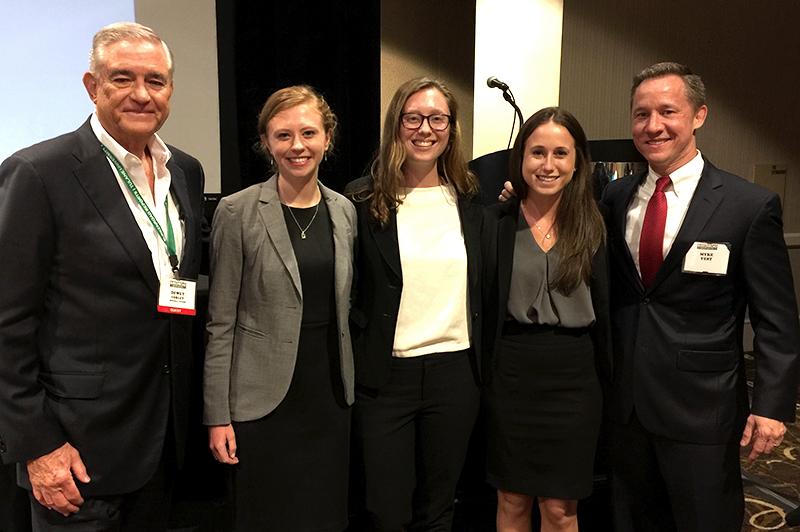
Freeman students Jodi Gottlieb (BSM ’17), Audrey Preston (BSM ’17), Brooke Satterfield (BSM ’17) and Cara Williamson (BSM ’17) took home first place honors in the second annual Aaron Selber Jr. Course in Alternative Investments Distressed Debt Investment Pitch Competition.
The competition, which took place April 28 at the Sheraton New Orleans Hotel in conjunction with the Burkenroad Reports Investment Conference, is the culmination of the spring edition of the Aaron Selber Jr. Course in Alternative Investments, which focuses on distressed debt.
Gottlieb, Preston, Satterfield and Williamson won over judges with their pitch for investing in the debt of Affinion Group, a provider of customer loyalty, customer engagement and insurance programs.
“The students amaze me with their depth of analysis and ability to present very complex investment ideas in a streamlined manner,” said Myke Yest, professor of practice in finance and course instructor. “Our judges had to select a winner, but all three teams did just an outstanding job.”
Serving as judges for the competition were Dewey Corley (L ’70), chief investment officer for the Selber Family Interests, Ron Bienvenu, general partner and founder of Spear Point Capital Management, and Joel Daste, founder of Gulf National Corp.
The Aaron Selber Jr. Course in Alternative Investments was established in 2015 through a gift of the Selber family to highlight two areas of investing close to the late Selber’s heart: distressed debt and hedge funds. During the spring semester, students learn about distressed debt through readings, lectures and presentations by guest speakers active in distressed debt investing. Toward the end of the semester, the students work in teams to analyze a distressed company and propose an investment that draws on strategies learned in the class. The top three teams in the class are then invited to participate in the competition.
“I love teaching this course because it allows students to think about investing in companies differently than is traditionally taught in school,” Yest said. “We normally think about investing in firms that are financially healthy and have great future prospects. In distressed debt, we look for companies that are facing financial distress and therefore have securities that are beaten up by the market. Opportunities may arise to buy debt instruments at pennies on the dollar. Holding these investments through a reorganization process, in or out of bankruptcy court, might allow the firm to survive its distress and allow the investor a handsome return.”
"Aaron was a great supporter of innovative educational programs, so it's only fitting that his name be associated with this unique course,” added Freeman School Dean Ira Solomon. "I think Aaron would be very pleased with both course and the rare skills it offers students.”
Interested in advancing your education and/or career? Learn more about Freeman’s wide range of graduate and undergraduate programs. Find the right program for you.
Recommended Reading
- Pros and Cons of Tariffs: What Finance Professionals Need to Know
- What Does a Controller Do?
- MBA vs. Master’s in Finance: Key Differences
- Investment Banker: Salary, Job Description, and Requirements
- How to Get Started in Sustainable Finance
- What Does It Take to Work in Government Accounting?
- Finance Curriculum vs. Accounting Curriculum: How Are They Different?
- Business Analytics vs. Finance: Which Master’s Degree Is Right for You?
Other Related Articles
- Alternative Investments Conference offers students a different path to success
- The Times-Picayune: 115-year-old Pan-American Life Insurance Group on track to surpass $2B in revenue
- Experts weigh in on the future of consulting
- For EMBA student, program is all about the journey
- S&P Global: US oil majors cast doubt on feasibility of net zero by 2050
- The Wall Street Journal: Selloff in U.S., European Government Bonds Deepens
- Evacuation app earns top prize in inaugural Freeman AI Innovation Challenge
- The Mirror: Oil and diesel crisis from Iran and Ukraine wars could last years, energy expert warns