
Experts weigh in on the future of consulting
With artificial intelligence now capable of generating a comprehensive business strategy in seconds, the consulting industry finds itself facing a stark new reality.
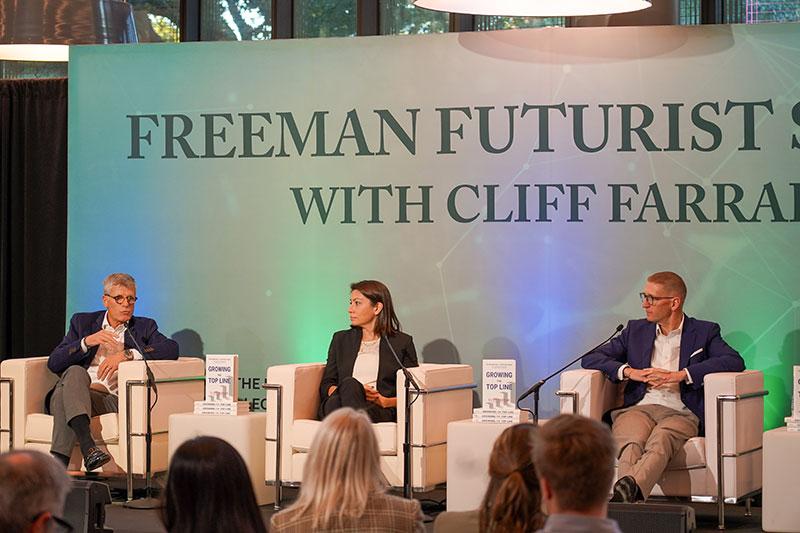
In a discussion at Tulane University’s Freeman School of Business on Oct. 15, a panel of leading consulting executives said ideas — traditionally the industry’s prime currency — are no longer enough. Clients want action.
“Ideas used to be a dime a dozen, and now they’re a penny a million,” said Benno Duenkelsbuehler, CEO and chief growth sherpa of Realign, a boutique consulting firm serving mid-market companies. “However many brilliant ideas Claude comes up with, they still need to be executed.”
The growing importance of execution was a key takeaway from “The Future of Consulting: How AI Is Reshaping the Traditional Consulting Model,” the latest installment in the business school’s Freeman Futurist Series.
Joining Duenkelsbuehler for a wide-ranging conversation on the future of the profession were Katie Scearce, managing director and North America lead, Corporate Strategy & Growth, with Accenture; and Ben Martin, vice president and general manager, Global Professional Services, with NetApp. Cliff Farrah, chief strategy officer, Corporate Strategy & Growth, at Accenture and executive-in-residence at the Freeman School, served as moderator.
For decades, consulting firms have operated on a time-and-materials basis, racking up big fees to produce slide decks, strategy reports and spreadsheets. With AI dramatically reducing the labor required to generate those outputs, firms and clients alike are increasingly opting for outcome-based models, which shift the focus from glossy deliverables to measurable results.
“In my world, (outcome based) means we’ve understood what the problem is, we’ve figured out how we can address that problem with technologies in our portfolio, we’ve agreed what success looks like, we’ve agreed on a price for it, and then we go in and deliver against that, no matter how long it takes,” Martin said.
Realign puts a revenue increase goal in writing at the beginning of an engagement, Duenkelsbuehler explained, and then offers its services at a heavily discounted price but with an added success fee, typically a percentage of the new revenue it's creating.
“So the closer we get from $50 to $100 million, we’re incentivized on that,” he said.
“(Organizations) need a partner in execution,” Scearce added. “They need someone to come in and de-risk the spend that they are putting out to deliver on a goal, and they need a partner to make sure it happens.”
Another topic the panelists addressed was AI’s impact on organizational structure. With firms increasingly turning to AI to perform tasks that entry-level associates once did, they risk losing the foundational knowledge and skills developed through doing that work.
“We have to watch out for that,” Scearce said. “If the teams are incredibly lean and the work that is coming to the top hasn’t been structured appropriately to begin with — hasn’t been reviewed in depth and edited along the way — you get to a place where the final product could very well be AI slop.”
The panelists urged students in attendance to build their AI fluency and learn how to collaborate with autonomous agents, but they also emphasized that AI can never replace relationships and trust.
“People don’t buy consulting companies,” Scearce said. “They buy relationships with those that they trust, and that trust equation is going to continue to be incredibly important.”
“Trust is the coin of the realm, and you need to build that,” added Martin. “AI can’t connect with you on a personal level in a genuinely authentic way. That human element is never going to be replaced.”
In the end, Farrah said that's a big reason why he remains bullish on the future of consulting.
“We talk a lot about what AI’s changing, but what it will not change is the importance of the trusted advisor,” he said. “You will never ever undergo any major transformation of your company without someone you trust helping you through that process.”
Interested in advancing your education and/or career? Learn more about Freeman’s wide range of graduate and undergraduate programs. Find the right program for you.
Recommended Reading
- A Guide to Using Accounting Information Systems
- Pros and Cons of Tariffs: What Finance Professionals Need to Know
- Audit vs. Tax Accounting: How Are They Different?
- What Does a Controller Do?
- MBA vs. Master’s in Finance: Key Differences
- How to Become a Tax Manager
- Investment Banker: Salary, Job Description, and Requirements
- How to Advance Your Accounting Career at Tulane
Other Related Articles
- Research Notes: Daniel Mochon
- Research Notes: Claire Senot and Yatish Hegde
- Research Notes: Carmen Weigelt
- WDSU News: Feast For Less: How to trim your Thanksgiving budget
- The Guardian: Tech’s biggest names sank a tax on billionaires’ wealth with $425m and a familiar playbook
- The Street: DoorDash makes a promise to Instacart members
- Alternative Investments Conference offers students a different path to success
- The Times-Picayune: 115-year-old Pan-American Life Insurance Group on track to surpass $2B in revenue