
Industry leaders tackle AI, automation and Louisiana’s economic future at Tulane Business Forum
At First Solar’s $1.1 billion manufacturing facility in Iberia Parish, sheets of glass traverse eight miles of robot-lined conveyor belts, emerging four hours later as finished solar modules without ever being touched by human hand.
But in an appearance at this year’s Tulane Business Forum, a top executive with the company, the nation’s largest manufacturer of utility-scale photovoltaic solar panels, said the plant’s AI-enabled automation hasn’t come at the expense of human workers.
“Before AI, we were producing 10,000 modules a day with 900 people,” said Georges Antoun, First Solar’s chief commercial officer. “After AI, we’re producing 17-18,000 modules per day with 900 people, so we almost doubled the productivity.”
Antoun was one of more than a dozen business, education and economic development leaders who came together to discuss technology-fueled innovations taking root in Louisiana at the 47th annual Tulane Business Forum. The event, a presentation of the Tulane Association of Business Alumni (TABA) at Tulane University’s A. B. Freeman School of Business, took place at the New Orleans Ernest N. Morial Convention Center on Oct. 30.
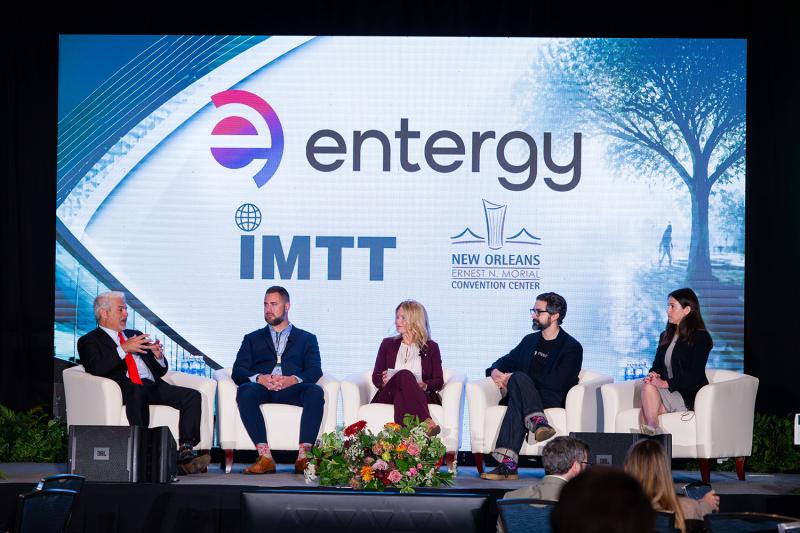
Joining Antoun for a panel discussion on automation, transformation and AI in the Gulf South were Curtis Blank Jr., director of maintenance and engineering with Associated Terminals, Michael Perry, head of commercial strategy with Persona AI, and Eliana Winderman, in-house counsel and AI committee chair with IMTT. Kimberly Graham, chief innovation and entrepreneurship officer with the Tulane Innovation Institute, served as session moderator.
While AI isn’t replacing workers at First Solar’s Iberia Parish plant, Antoun said it is affecting hiring in other ways.
“It changed the scope of who we’re looking for,” he said. “We’re looking for decision-makers. We’re looking for judgment. We’re looking for critical thinkers. We’re looking for problem solvers rather than people moving one part from one place to another. And that is a different level.”
One of the company’s biggest challenges in the area of AI has nothing to do with technology. It’s grappling with shifting policies at the federal level.
“Anyone that’s spending hundreds of millions of dollars, it’s important for them to understand if they can recover that investment,” Antoun said. “The policies have to be stable. I don’t care what the policy is, but it has to be there for years to come.”
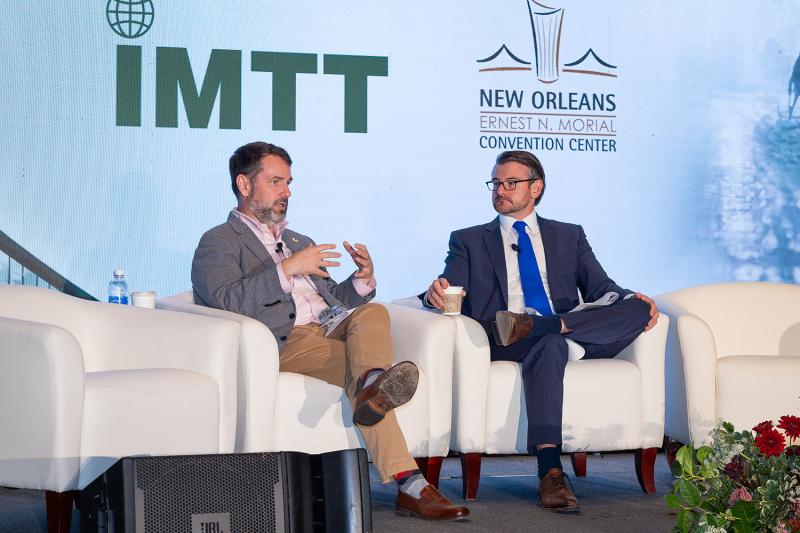
AI was also a topic discussed by Josh Fleig, chief innovation officer with Louisiana Economic Development, and Rob Lalka, executive director of the Freeman School’s Lepage Center for Entrepreneurship and Innovation, in a fireside chat session, but their focus was on the more than $260 billion in AI infrastructure projects that Meta, Amazon and SpaceX have recently committed to Louisiana. To make the most of this once-in-a-generation opportunity, Fleig argued that it’s essential for the state to avoid the mistakes it made in the wake of the chemical manufacturing boom of the 1960s and ’70s.
“We create the resin and the plastic pellets that are put on a barge and sent to China, Temu makes something out of them, and then we order them back to Louisiana, so the value accrues to Temu,” Fleig said. “It’s not accruing to a company here in Louisiana from all the infrastructure that was built during that industrial boom. Now we’re front and center of this AI infrastructure build-out. However, we have to build companies where the value will accrue to Louisiana companies. Because if we do nothing, that data center comes online, and the value will accrue to some startup in Silicon Valley. That is our No. 1 challenge.”
Tulane President Michael Fitts kicked off the forum with an overview of Tulane’s role in the local and state economy, including the university’s $500 million commitment to develop the former Charity Hospital building into a hub for research, education and innovation. Other sessions included a panel discussion on venture capital and private equity, a presentation on the state of healthcare in Louisiana, and a luncheon keynote discussion on the next generation of New Orleans sports infrastructure. Freeman School Dean Paulo Goes also delivered a brief update on the Freeman School before introducing the keynote.
The Tulane Association of Business Alumni (TABA) represents over 25,000 worldwide alumni of the A. B. Freeman School of Business, and the Tulane Business Forum is its marquee event. Each year, the forum presents speakers of local, national and international acclaim who address important business topics of the day.
Interested in advancing your education and/or career? Learn more about Freeman’s wide range of graduate and undergraduate programs. Find the right program for you.
Other Related Articles
- The Guardian: Tech’s biggest names sank a tax on billionaires’ wealth with $425m and a familiar playbook
- Why Software Subscriptions Might Actually Be Fueling Digital Piracy
- CNBC: Meta’s $18 billion settlement puts TikTok and YouTube on notice. Who’s next on the firing line?
- Fortune: Don’t praise Meta ‘for what the court orders them to do’: Meta will only pay the full $17.1 billion settlement if TikTok and YouTube match it
- MarketWatch: Meta dodges ‘Big Tobacco’ nightmare with $18 billion settlement in child-safety lawsuit
- Yahoo! Finance: Meta faces risks whether it wins or loses major social media trial
- Wired: SpaceX IPO Puts Elon Musk’s ‘Extreme’ Ownership to the Test
- Business Insider: The workers Meta and Google desperately need aren't in Silicon Valley